What age is the ELEGOO Conqueror Robot Tank Kit actually appropriate for?
ELEGOO sets the recommended age at 10 years and up, even though the product name also markets it to children of 8 and older. Eight and nine year olds can build it happily, usually with a parent helping on the electronics so connectors do not get broken. Treat it as a shared build for children at the younger end, and a more independent project for pre-teens and teens.
Do you need to know how to code already to use this kit?
No. The kit is designed to be programmed in two stages: first through the ElegooKit app's block-based visual coding, which needs no prior programming knowledge, and later in the Arduino IDE for kids who want to change motor speed, sensor thresholds or servo movement directly in code. The UNO R3 controller supports both, so a complete beginner can get going with blocks and grow into text-based coding without a different board. It also runs straight after building, with nothing to upload.
How well do the FPV camera and app controls work?
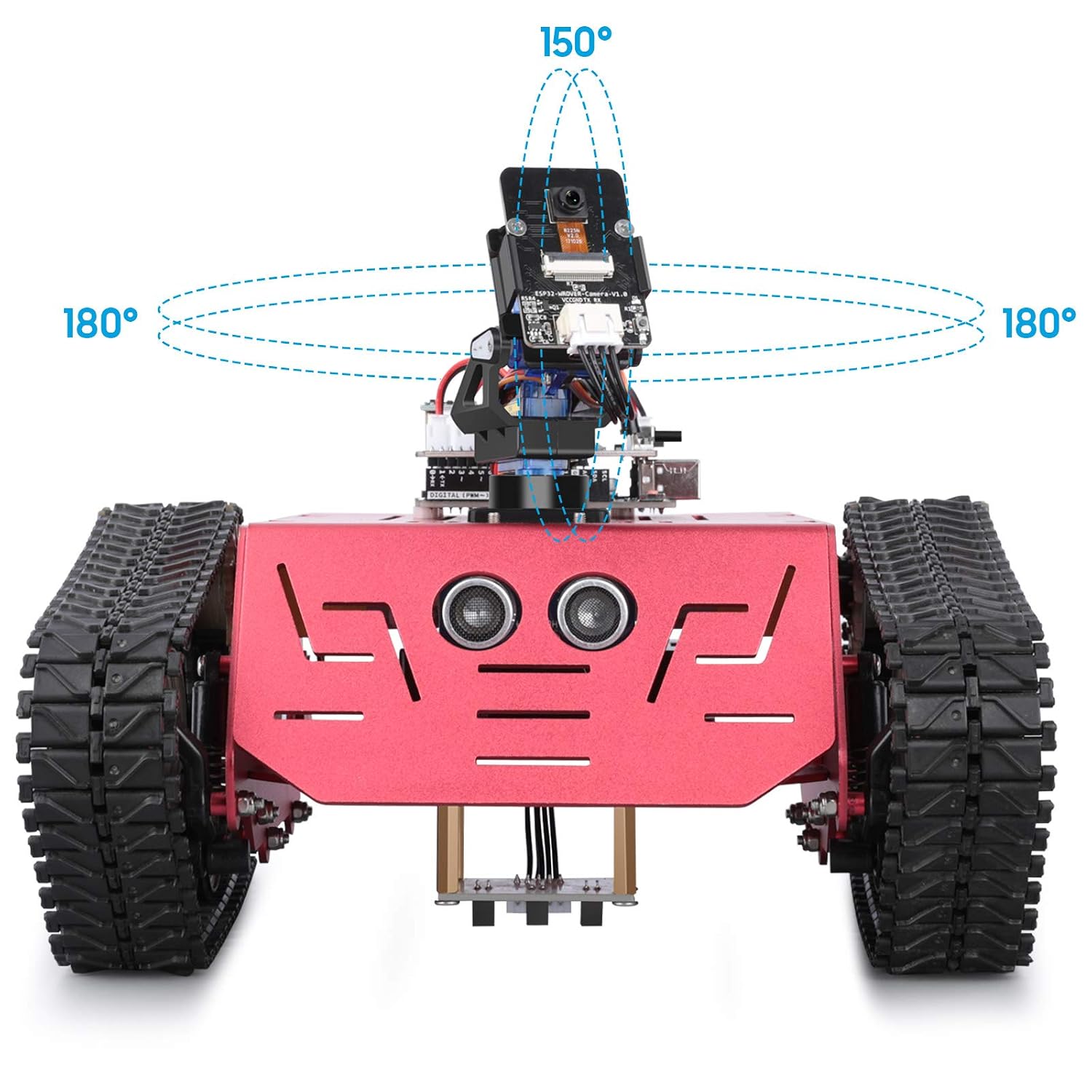
This is the kit's weakest area. Buyers rate controls and connectivity negatively and functionality as mixed. The FPV mode streams video from the OV2640 camera over an ESP32-WROVER Wi-Fi module to a phone. Some owners drive from the phone happily, though it is hard to see in a dark room, while one could see the camera feed but could not get the tank or the camera servo to respond to the app. Buy it for the build and the coding path, and treat FPV control as a bonus that may need some troubleshooting.
Does the kit require soldering?
No. ELEGOO sells it as a complete no-solder project kit: the UNO R3 controller, metal chassis, tracks, camera, ultrasonic and line-tracking modules, motors and servos all connect without soldering. Buyers consistently rate assembly highly, and the printed instructions, plus the even clearer version in the ElegooKit app, make the build manageable for a first-timer. It still takes real time rather than a few minutes.
Is it good value for what you get?
For a learning project, yes. Build quality, assembly, fun and educational value are all strong points, and a stainless-steel tank with a camera, five modes and a board that grows from block coding into Arduino code gives a lot to work with. One owner felt it was not very user friendly for the money, and the controls and connectivity are where the kit falls short. If you want a flawless remote-control toy, look elsewhere; if you want a real build that teaches, it earns its keep.
Can the tank actually navigate on its own, or does it need to be driven?
Both. Beyond FPV and IR remote driving, the kit has obstacle avoidance and line tracking modes that let the tank navigate using its onboard sensors, plus an auto follow mode, for five modes in total. Line tracking relies on a board that hangs low under the chassis, and owners who drive over rough ground often leave it off because it catches. As with the remote and app, the electronics behind these modes are where most of the fiddling happens.